Happy Summer Everyone! Wow, it seems as though Rochester winter is never ending. Once the warmer weather hits, it helps bring us out of hibernation mode. Though there are several ways to prioritize produce and stay active year round, I really look forward to reaping the benefits of the Rochester summer. One of those benefits being the daily dose of vitamin D and getting outside, and another being utilizing different seasonal produce. Both carry a variety of benefits!
Benefits of Getting Outside
You may notice during the summer, with longer days and sunnier weather, that moods tend to lift and motivation appears higher. There is actually research to prove this! A cross-sectional and longitudinal study in over 400,000 participants reported that each additional hour spent outdoors during the day was associated with lower odds of lifetime major depressive disorder, antidepressant usage, less frequent anhedonia and low mood, greater happiness. In addition, each hour of daytime light was associated with greater ease of getting up, less frequent tiredness, fewer insomnia symptoms.
Furthermore, an article from the American Psychological Association noted exposure to nature has been linked to several benefits, including improved attention, lower stress, better mood, reduced risk of psychiatric disorders, and even an increase in empathy and cooperation. The majority of research thus far has focused on green spaces such as parks and forests. But now, researchers are also beginning to study the benefits of blue spaces, such as sights of river and ocean views. But nature comes in all shapes and sizes, and psychological research is still fine-tuning our understanding of its potential benefits. That being said, exposure to sunlight (while wearing appropriate sunscreen of course), can be a great focus point this season. Even if it’s a weekend hike or prioritizing getting outside during your lunch break if feasible. There are several local places you can check out to hike in the area to increase your exposure to both green space and blue space. You can also consider making small, more manageable changes to get outside. Generally, there are many tasks to do outside, such as gardening, landscaping, lawnmowing, or taking the dog for a walk. But consider adding in leisure time outside – consider taking time to sit outside for your first sip of coffee or even taking 5 deep breaths outside first thing in the morning or right before bed!
Benefits of Seasonal Produce
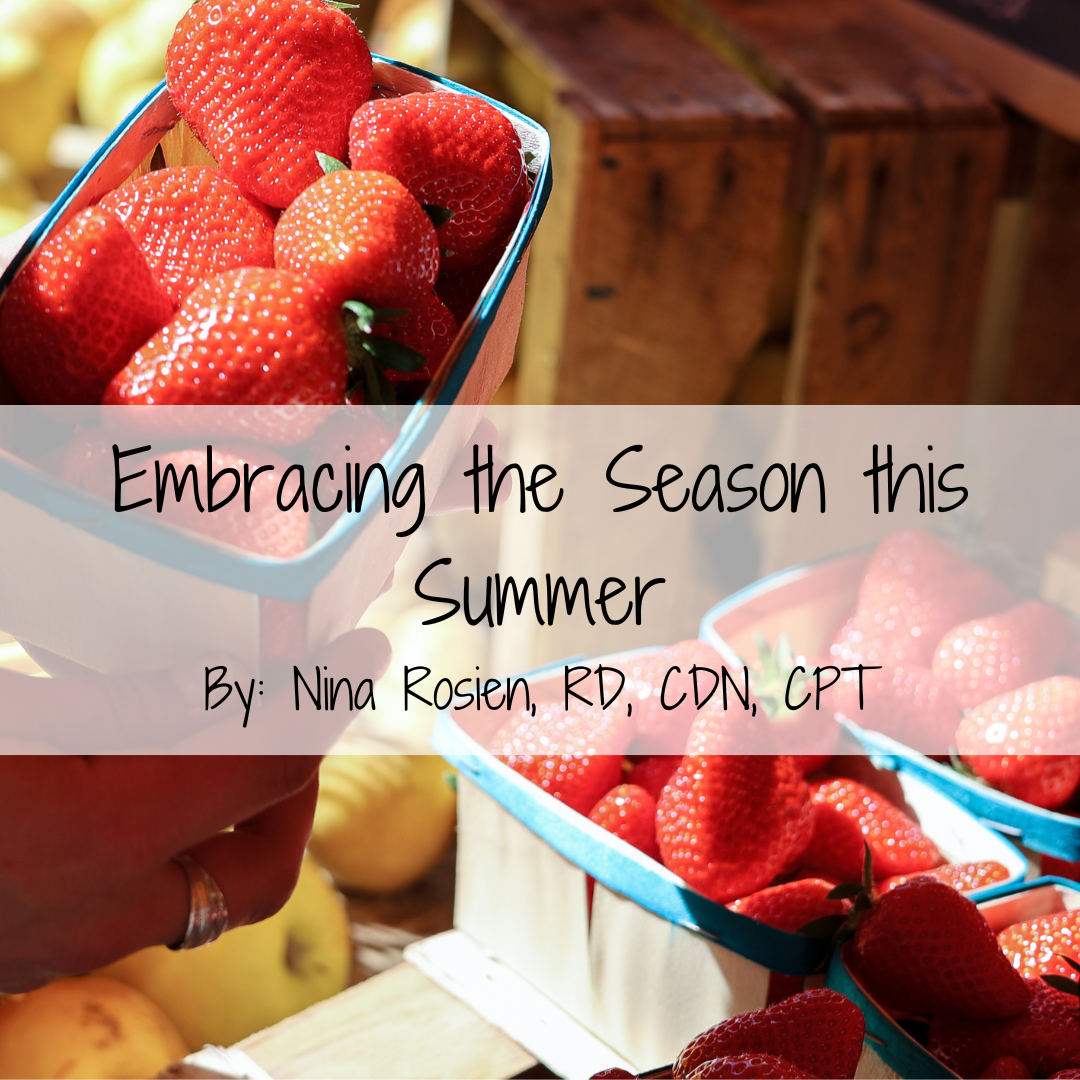
There are several motivating factors for trying to include more seasonal and summer produce. Buying seasonal produce can be tastier, which can increase motivation to try and boost produce consumption. It can also be cost effective, as those items are more plentiful when they are in season making them more accessible and easy to distribute. And lastly, utilizing produce that is in season in the summer can help us include more of a variety of produce in our diet. A study suggested incorporating a high diversity of plants contributes to the variety of fiber types that act as food for gut microbes, with the potential to support a wide range of species. In this study, people who ate 30+ different plants per week not only had higher microbial diversity than people who reported eating fewer than 10, but they also had a higher diversity of compounds.
That being said, let’s use this time we have in a Rochester summer to explore produce options you’ve never had before. Consider going to the farmer’s market with a friend or your kiddo, have them choose an item for you! Or for those bulk items, go in on it with your friend so you try something new without the commitment of having pounds of produce. The farmer’s market can also be the way that you get the exposure to sunlight as well! Here are some ideas for farm stores and utilizing local U-pick locations:
- Hurd Orchards – Each month of the summer, they have U-pick options for a variety of different produce.
- CSAs- Community Supported Agriculture is a perfect way to up your produce intake. It allows you to get so much variety without having to choose what to get!
- Local farm stores – If you prefer to choose your own produce, check out one of the many local farm stores in the Rochester area.
Some challenges that I hear of in discussions about including produce diversity is making produce last. Luckily there are a couple ways that come to mind where produce use can be spread out – to maintain costs, decrease food waste, and be able to enjoy tasty produce for longer!
- Consider utilizing “sturdy” produce – What this means is you can begin this journey by choosing produce that has a larger shelf life! Produce that tend to have a shorter shelf life sneak up on us when they go bad. One second we bring it home from the grocery store, and within a day or two it’s already starting to wilt. But there’s some produce that can last quite long when stored properly. See below for some examples:
- Carrots – If kept in a high humidity drawer, these can be kept for weeks!
- Cabbage – Similar to carrots, if kept in a high humidity drawer, these can be kept for several weeks, or even longer.
- Radishes – Remove the roots and leaves and wrap with a damp paper towel. Place these loosely in a plastic bag and they can last up to 2 weeks!
- Learn how to store, or spread use of them – One of the most cost efficient ways to buy produce is buying in bulk. An example of this can be berry picking! But normally the outcome is that you drive home with pounds of berries and end up getting burnt out from having to find ways to use them or eat them. You can spread use of them out throughout the year by freezing them, using this method:
- Rinse berries to clean
- Lay flat on cookie sheet
- Put in freezer uncovered for ~2 hours
- Transfer into individual bags, and put back in freezer
You can also do this for other produce, such as zucchini. You can do this by cutting into desired shapes (cubed, sliced, etc.),. Then blanch the zucchini by boiling for 1 minute, then putting in an ice bath for cooling for 3-5 minutes. Drain, and immediately store in an air tight plastic bag in the freezer. That way you can have that summer fresh zucchini in a winter casserole months down the line!
Lastly, let’s be creative with this seasonal produce! Here are some less common ways to use up some of that seasonal produce we have more exposure to:
- Grilled peaches – This is one of my FAVORITES. Cut peaches in half, leave the skin on, sprinkle with a little cinnamon, and grill. If you’re feeling fancy, add a little brush of local maple syrup at the end of grilling, and top with whipped cream to serve!
- Zucchini tots – Growing up, I loved a good tater tot. And now as an adult, I was always looking for a different spin on this. Zucchini is so plentiful this time of year, and this is a great way to use it up. You can even get the kids involved to help put this one together!
- Grilled vegetable hash – I am always looking for ways to get vegetables for breakfast. I highly recommend grabbing a bunch of summer vegetables (zucchini, tomatoes, etc.) and throwing them on the grill in bulk, and then you can keep them in the fridge for a few days. This can quickly be sauteed with eggs and breakfast sausage for breakfast. If you want to go beyond this, then you can simply have the veggies on the side of any meal to add more color and flavor!
In summary, tis’ the season! Experiment with any of the above recommendations to add a touch of summer flare to your health journey.
Sources –
- Burns AC, Saxena R, Vetter C, Phillips AJK, Lane JM, Cain SW. Time spent in outdoor light is associated with mood, sleep, and circadian rhythm-related outcomes: A cross-sectional and longitudinal study in over 400,000 UK Biobank participants. J Affect Disord. 2021 Dec 1;295:347-352. doi: 10.1016/j.jad.2021.08.056. Epub 2021 Aug 27. PMID: 34488088; PMCID: PMC8892387.
- Wallnoefer LM, Riefler P, Meixner O. What Drives the Choice of Local Seasonal Food? Analysis of the Importance of Different Key Motives. Foods. 2021 Nov 6;10(11):2715. doi: 10.33Gascon,
- M., et al., International Journal of Hygiene and Environmental Health, Vol. 220, No. 8, 201790/foods10112715. PMID: 34828997; PMCID: PMC8623070.
- McDonald, D., Hyde, E., Debelius, J. W., Morton, J. T., Gonzalez, A., Ackermann, G., Aksenov, A. A., Behsaz, B., Brennan, C., Chen, Y., DeRight Goldasich, L., Dorrestein, P. C., Dunn, R. R., Fahimipour, A. K., Gaffney, J., Gilbert, J. A., Gogul, G., Green, J. L., Hugenholtz, P., Humphrey, G., … Knight, R. (2018). American Gut: an Open Platform for Citizen Science Microbiome Research. mSystems, 3(3), e00031-18. https://doi.org/10.1128/mSystems.00031-18